Summary
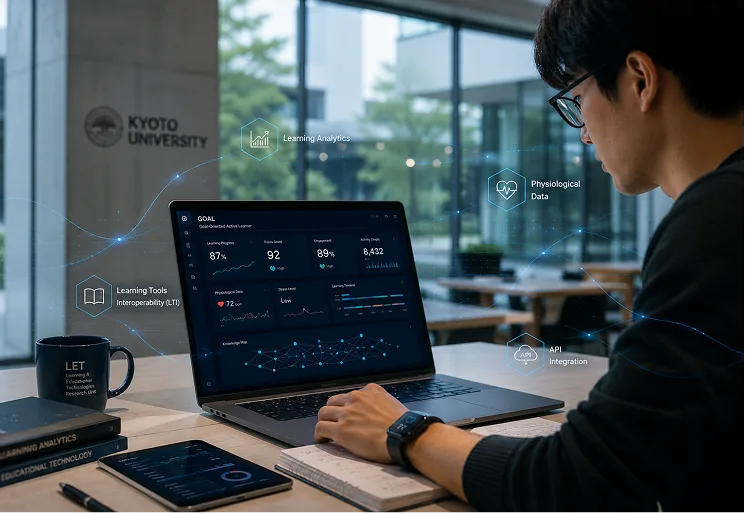
Kyoto University's LET Research Unit was building GOAL (Goal-Oriented Active Learner), a platform that helps learners become self-directed by synchronizing their learning activity with their physical activity data. Plaxonic provided the engineering behind it: API integration for data gathering and visualization, a MongoDB pipeline for capturing learner interactions, and device connectivity for physiological data.
The Challenge
The research unit needed engineering expertise to turn the GOAL concept into a working platform. That meant integrating a range of APIs for data gathering and visualization, exporting GOAL interactions as structured API statements into MongoDB, and connecting physiological-data devices so the platform could support learners as they analyze, plan, monitor, and reflect on both their study and their physical activity.
How We Helped
Plaxonic worked closely with the LET Research Unit to understand their research objectives and design a custom solution to match. We brought technical expertise in API integration, data visualization, and device connectivity to build a robust, scalable platform, working in agile iterations with continuous communication throughout delivery.
Our Approach
API integration: we integrated the required APIs, including Empatica and Emotiv, into the GOAL system to gather data and generate visualizations, linked to specific users within a session for personalized data collection.
API statements: we exported GOAL interactions as structured statements into MongoDB, following the existing pipeline pattern from the platform's eBook reader, so interactions were stored efficiently and available for analysis.
Device integration: we connected physiological-data devices through APIs, using the platform's Learning Tools Interoperability (LTI) functionality for seamless integration.
Data visualization: we used the platform's Angular graphing libraries to visualize and export synchronized signals, so learners could analyze, plan, monitor, and reflect on their combined learning and activity data.
The Technology
Node.js for server-side applications and API integration. React for the user interface and data visualization. MongoDB to store and export learner interactions as structured statements. Git for version control. Docker to containerize and automate deployment for scalability and easier maintenance.
The Result
Plaxonic helped the LET Research Unit build a robust, scalable GOAL platform that supports self-directed learning by bringing study and physical-activity data together in one place.
In Their Words
"Plaxonic's expertise was instrumental in developing our GOAL platform. Their proficiency in API integration and data visualization led to a robust and user-friendly system that perfectly aligns with our vision of fostering self-directed learning. A truly reliable and innovative partner."
— Dr. Rwitajit Majumdar, Principal Investigator, Learning and Educational Technologies (LET) Research Unit, Kyoto University